Showing posts with label courses. Show all posts

Sunday, April 07, 2019

Online Courses Search - Private College Programs IPEDS 2016

Begin

Note: Information provided in this article is obtained from the project 'DataMaster -IPEDS'. Detail of the project can be found in Youtube, and EdPond articles.

Using Panels provided by this tool, readers can locate online courses offered by the private colleges of the United States. The project is hosted at the Tableau Public. For online program offered by the public colleges of the United States, please see this tools/application.

Through the years, based on US Education Department's IPEDS (Integrated Postsecondary Education System) survey, the per-cent of students involved in distance classes have increased in almost all sectors of 2-year and 4-year colleges. The recent trend from year 2012 to 2016 can be visualized in my previous article:
"IPEDS College Data - Online/Distance Education Enrollment Trend".

Even though not directly related, private institutions in the United States also provide opportunities for students to obtain degrees through distance education 'completely'. Based on IPEDS definition, a 'Distance Education Program' is a program for which all the required coursework for program completion is able to be completed via distance education courses, in which the instructional content is delivered exclusively via distance education. IPEDS' definition for 'Distance Education Course' do reserve the possibilities that students maybe asked to physically participate in some activities like testing, orientation, or academic support services. This can mean that, in reality, some of the degrees listed in this articles may not be completely feasible remotely.

Anyway, it is the intention of this article to provide a list of disciplines and colleges that were reported to IPEDS as 'Distance Education Program'. Students are cautioned to check the details with institutions before committed to work toward the degrees.

Given all the above, let's now look at the overall picture of the 'Distance Education Program' offered by United States' private institutions.

Based on the IPEDS data, there are total 14,909 distance education programs offered by United States' private institutions, 4-year or 2-year. Of these programs, 3,853 are in the Associate or Certificate level. At the Bachelor-degree level, there are 5,181 programs. At higher degree levels, there are 1,017, 4,453, 378, and 27 programs respectively for post-bachelor, master, post-master, and doctor degree.

Information about these distance education programs can be examined via the following interactive panels.

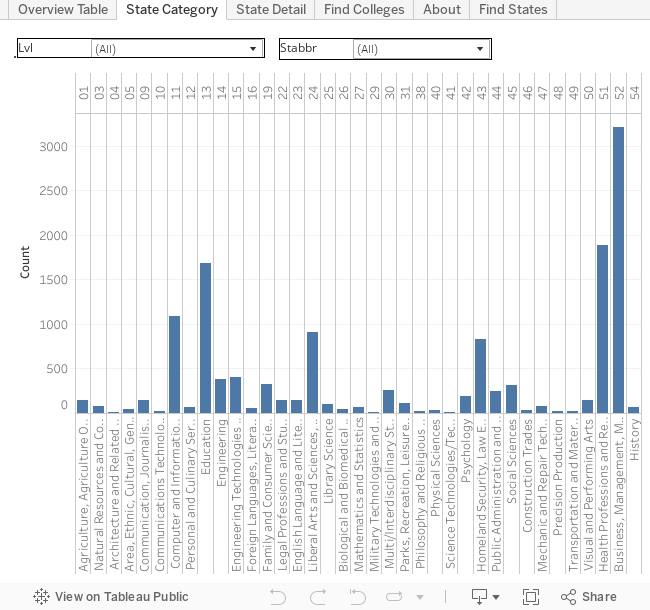
Panel 1 - State Category
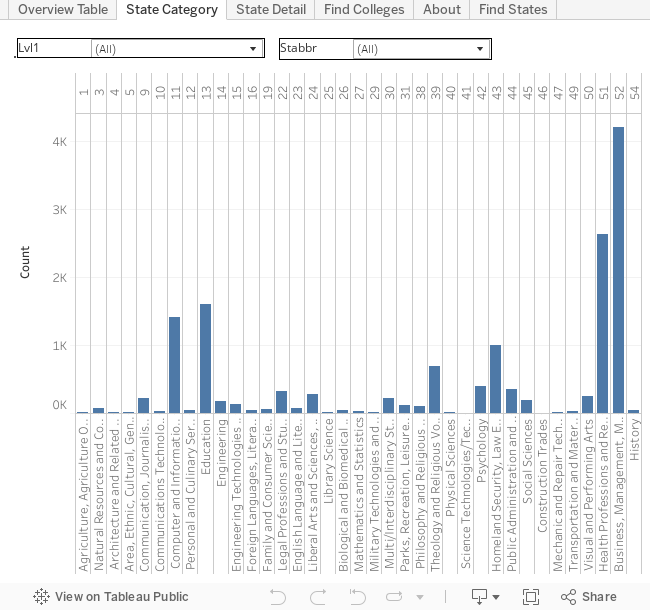
In panel 1, by selecting the state of interest and the degree level, user can exam the number of (distance education) programs offered in each discipline branch, depicted by the two-digit CIP (Classification of Instructional Program) code. By selecting all levels and all states, it can be observed that most programs are offered at the category of CIP 52, the Business, followed by CIP 51, the Health, and CIP 13, the Education branch. Summing over all states, at the Associate and Certificate level, the CIP 11, the Computer, ranked 3rd instead of CIP 13, the Education. At the bachelor level, CIP 24, the Libral Art, comes before CIP 13, and ranked as the 3rd. At the post bachelor and master level, CIP 13 is way ahead of Business (CIP 52) and Health (CIP 51), where they are of similar magnitude and traded each other with levels. For the doctor level, there are only 3 CIPs: 51, 13, and 44 (social services).

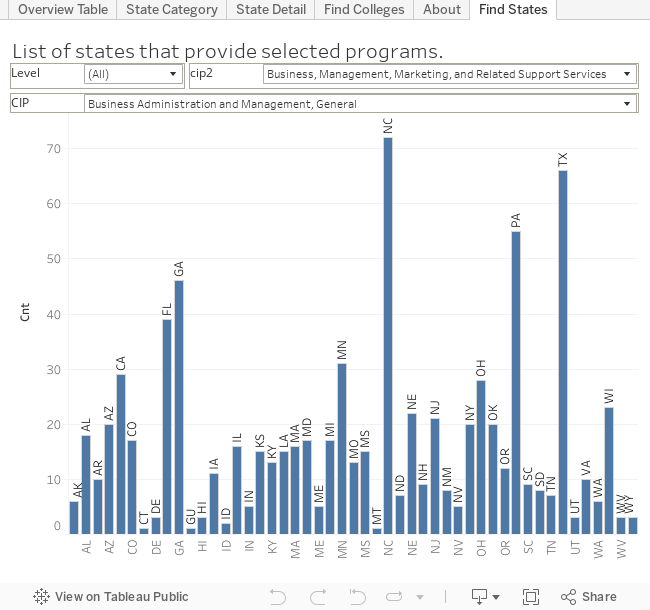
The state summary in Panel 1 is good if you are interested in in-state degrees. However, an online program being an online program is the freedom to enrolled from anywhere. In this case, searching from the program of interested maybe the way to go. Panel 2 shows exactly that.

Panel 2 - Find States
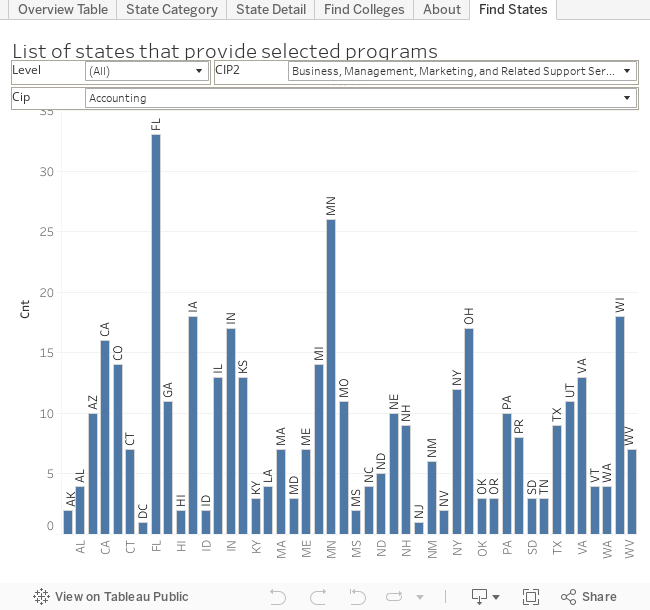
In Panel 2, reader can select the degree level:
    Assoicate and Certificates (DeCrtAssct)
    Bachelor (DeBchlr)
    Post Bachelor Certificates (DePstBchlr)
    Master (DeMstr)
    Post Master Certificates (DePstMstr)
    Doctor (DeDctr)
, the two-digit cip category, and, then, the cip program title. This allows reader to see from which states the selected programs are available. With this information, reader can continue to find out which college/institution offering the particular program.
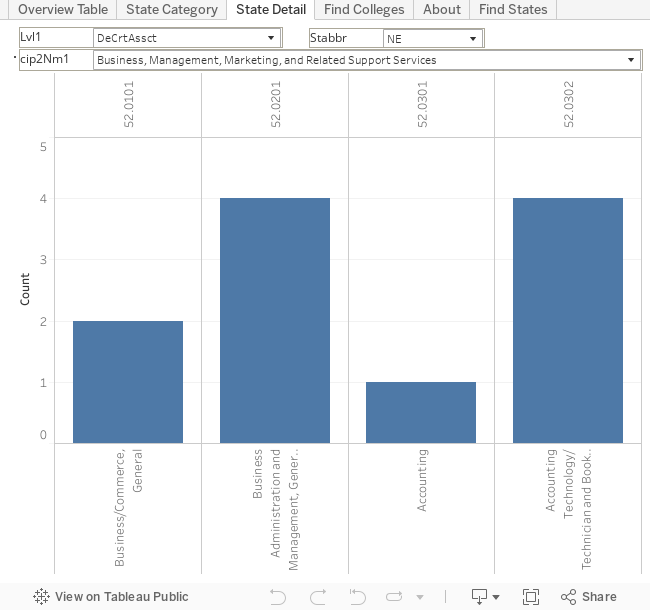
Panel 3 - State Detail

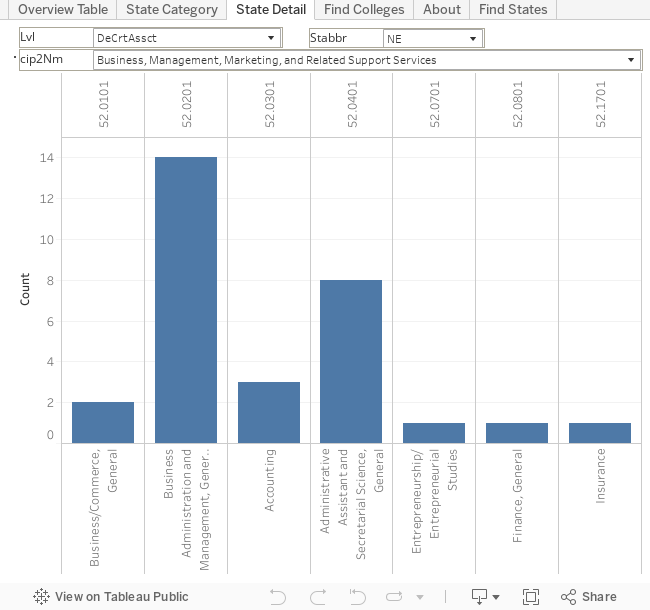
With this above panel, reader can find specific programs offered at the 6-digit CIP level - example are the Accounting training in the Business field (CIP 52).

Panel 4 - Find college
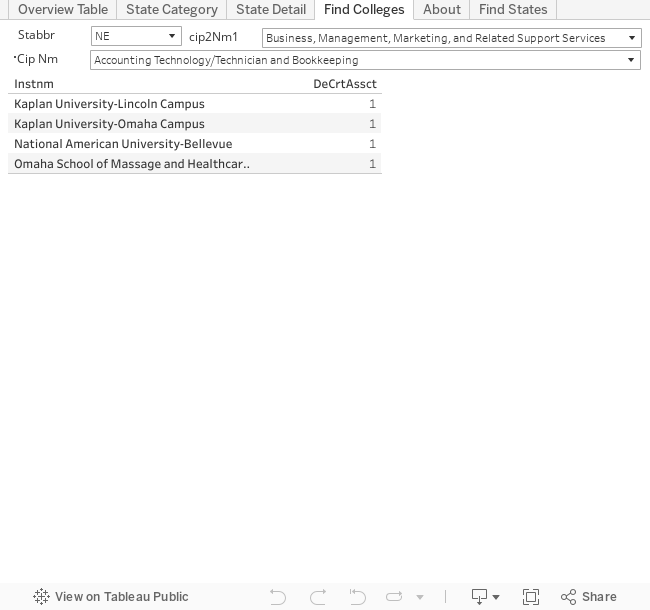
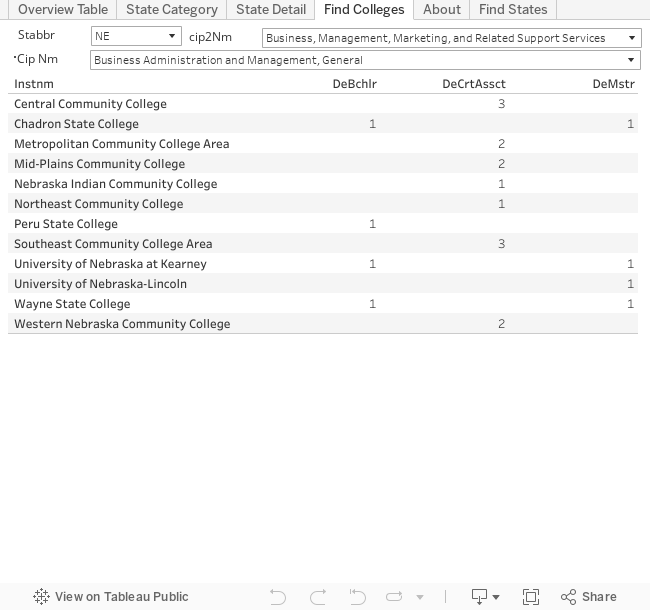
With Panel 4, reader can narrow their selection to the desired programs and the colleges that offered the programs.

Panel 5 - Overview Table
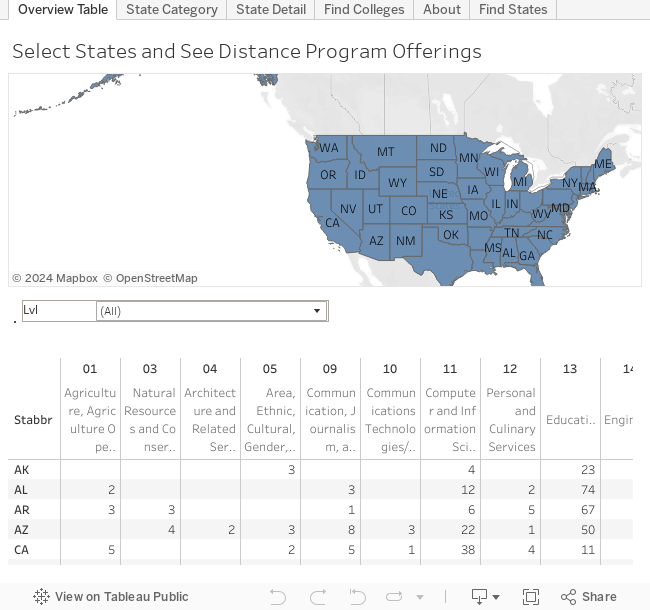
Panel 5 allows readers to compare program offered by each state. By selecting the desired states, readers can view program offerings side by side. For policy makers and higher education leaders, these data can be important in making decisions on what program to provide for the benefits of the society.

End
Monday, April 01, 2019

Online Courses Search - Public College Program IPEDS

Begin

Note: Information provided in this article is obtained from the project 'DataMaster -IPEDS'. Detail of the project can be found in Youtube, and EdPond articles.

Using Panels provided in this tool/article, readers can locate online courses( program) offered by the public colleges of the United States. The project is hosted at the Tableau Public. For online programs offered by the private colleges of the United States, please see this article.

Through the years, based on US Education Department's IPEDS (Integrated Postsecondary Education System) survey, the per-cent of students involved in distance classes have increased in almost all sectors of 2-year and 4-year colleges. The recent trend from year 2012 to 2016 can be visualized in my previous article:
"IPEDS College Data - Online/Distance Education Enrollment Trend".

Even though not directly related, public institutions in the United States also provide opportunities for students to obtain degrees through distance education 'completely'. Based on IPEDS definition, a 'Distance Education Program' is a program for which all the required coursework for program completion is able to be completed via distance education courses, in which the instructional content is delivered exclusively via distance education. IPEDS' definition for 'Distance Education Course' do reserve the possibilities that students maybe asked to physically participate in some activities like testing, orientation, or academic support services. This can mean that, in reality, some of the degrees listed in this articles may not be completely feasible remotely.

Anyway, it is the intention of this article to provide a list of disciplines and colleges that were reported to IPEDS as 'Distance Education Program'. Students are cautioned to check the details with institutions before committed to work toward the degrees.

Given all the above, let's now look at the overall picture of the 'Distance Education Program' offered by United States' public institutions.

Based on the IPEDS data, there are total 13,380 distance education programs offered by United States' public institutions, 4-year or 2-year. Of these programs, 7,264 are in the Associate or Certificate level. At the Bachelor-degree level, there are 2,105 programs. At higher degree levels, there are 945, 2,820, 241, and 5 programs respectively for post-bachelor, master, post-master, and doctor degree.

Information about these distance education programs can be examined via the following interactive panels.

Panel 1 - State Category

In panel 1, by selecting the state of interest and the degree level, user can exam the number of (distance education) programs offered in each discipline branch, depicted by the two-digit CIP (Classification of Instructional Program) code. By selecting all levels and all states, it can be observed that most programs are offered at the category of CIP 52, the Business, followed by CIP 51, the Health, and CIP 13, the Education branch. Summing over all states, at the Associate and Certificate level, the CIP 11, the Computer, ranked 3rd instead of CIP 13, the Education. At the bachelor level, CIP 24, the Libral Art, comes before CIP 13, and ranked as the 3rd. At the post bachelor and master level, CIP 13 is way ahead of Business (CIP 52) and Health (CIP 51), where they are of similar magnitude and traded each other with levels. For the doctor level, there are only 3 CIPs: 51, 13, and 44 (social services).

The state summary in Panel 1 is good if you are interested in in-state degrees. However, an online program being an online program is the freedom to enrolled from anywhere. In this case, searching from the program of interested maybe the way to go. Panel 2 shows exactly that.

Panel 2 - Find States

In Panel 2, reader can select the degree level:
    Assoicate and Certificates (DeCrtAssct)
    Bachelor (DeBchlr)
    Post Bachelor Certificates (DePstBchlr)
    Master (DeMstr)
    Post Master Certificates (DePstMstr)
    Doctor (DeDctr)
, the two-digit cip category, and, then, the cip program title. This allows reader to see from which states the selected programs are available. With this information, reader can continue to find out which college/institution offering the particular program.

Panel 3 - State Detail

With this above panel, reader can find specific programs offered at the 6-digit CIP level - example are the Accounting training in the Business field (CIP 52).

Panel 4 - Find college

With Panel 4, reader can narrow their selection to the desired programs and the colleges that offered the programs.

Panel 5 - Overview Table

Panel 5 allows readers to compare program offered by each state. By selecting the desired states, readers can view program offerings side by side. For policy makers and higher education leaders, these data can be important in making decisions on what program to provide for the benefits of the society.

End
Monday, November 12, 2018

Online Education Statistics (IPEDS Enrollment Trend)


If you are looking for online program offered by United States' public colleges, please use this online search tool/application to find colleges offering them.

With higher education continuing to be considered the footstep to reaching personal economic sufficiency, the demand for postsecondary education continues to grow. With the growing demands, governments, states, private companies, and institutions were working hard to capitalize and meet the demands. Distance education, with its nature, overcome several traditional higher education limitations.

Basic statistics of the distance education in United States were published in the 'Digest of Education Statistics' by National Center for Education Statistics (NCES). The most recent summary table published can be found here.

The table presents national level data with sector break down using the preliminary 2016 IPEDS (Integrated Postsecondary Education Data System) data published back in Feb. 2018. The table shows two years (2015 and 2016) of data, which are of limited use in showing the trends.

The purpose of this article is to fill the gaps and present some trend data using the 'data master' data system developed by the author. Information about the data system can be found at the ITTidbit, the Youtube, and the Vimeo.

For this article, I will be dealing with the National level data only as opposed to State level data, which will be dealt with in separate articles. The data presented here would be an enhancement to the basic statistics published by NCES in terms of the years of coverage, the break down of categories, and the revision of the data. The data used are revisions published by IPEDS as of Oct. 24, 2018.

The general observations of the data are:
  1. For degree-seeking students (include graduate students), which is the majority of undergraduates, the fraction of students taking online classes continue to grow.
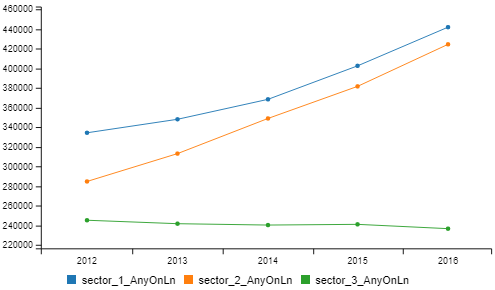
  2. For 4-year schools, public and private not-for-profit schools, the number of students taking online classes are continue to grow.
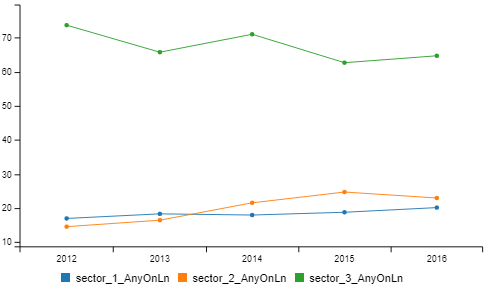
  3. For 4-year degree seeking, private for-profit schools show high degree use of distance education - 65-80% vs. 15-30% for public and private not-for profit schools.

DC+50States of US; 4-year Inst.; Undergraduate Total; Any Online Course;

  Head Count : (4-year; Under)
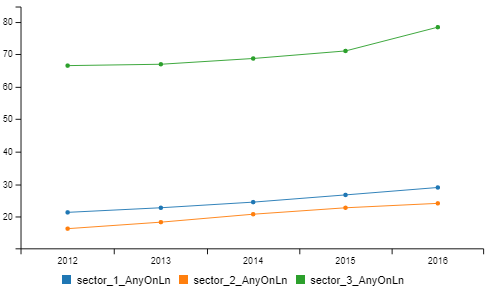
The chart above presents the enrollment headcount for undergraduate students that taking any online course in 4-year institutions located in the DC or the 50 states of United States. The blue line represents the public 4-year institutions while the orange line represents the private not-for-profit 4-year institutions. The green line represents the private for profit 4-year institutions.

  Percent of Undergraduate Enrollment : (4-year; Under)
Head count is important, but it does not tell the whole story. Percent of total enrollment provides a different level of details. As shown in this above chart, the private for-profit institution (green line) actually utilized the distance education to higher degree while the public 4-year institution (blue line) comes next even though it has more students as shown in previous chart.

DC+50States of US; 4-year Inst.; Undergraduate Degree Seeking; Any Online Course;

  Head Count : (4-year; Under; Degree Seeking)

The chart above presents the enrollment headcount for undergraduate degree seeking students that taking any online course in 4-year institutions located in the DC or the 50 states of United States. The blue line represents the public 4-year institutions while the orange line represents the private not-for-profit 4-year institutions. The green line represents the private for profit 4-year institutions.

  Percent of Undergraduate Degree Seeking Student : (4-year)

DC+50States of US; 4-year Inst.; Undergraduate non-Degree Seeking; Any Online Course;

  Head Count : (4-year; Under; non-degree seeking)

  Percent of Undergraduate non-Degree Seeking students: (4-year)


DC+50States of US; 4-year Inst.; Graduate; Any Online Course;

  Head Count : (4-year; Graduate students)

The chart above presents the enrollment headcount for graduate students that taking any online course in 4-year institutions located in the DC or the 50 states of United States. The blue line represents the public 4-year institutions while the orange line represents the private not-for-profit 4-year institutions. The green line represents the private for profit 4-year institutions.

  Percent of Graduate enrollment : (4-year)


DC+50States of US; 2-year Inst.; enroll total; Any Online Course;

  Head Count : (2-year; enroll total)

The chart above presents the enrollment headcount for undergraduate students that taking any online course in 2-year institutions located in the DC or the 50 states of United States. The blue line represents the public 2-year institutions while the orange line represents the private not-for-profit 2-year institutions. The green line represents the private for profit 2-year institutions. One thing stand out in this chart is that the public 2-year institutions have much more students than that of private 2-year institutions.

   Percent of enrollment total : (2-year)


DC+50States of US; 2-year Inst.; degree seeking; Any Online Course;

  Head Count : (2-year; degree seeking)
Again, comparing with previous chart, it shows that majority undergraduate students are degree seeking students. For data concerning non-degree seeking students, please see the following section.

   Percent of degree seeking students : (2-year)
   
DC+50States of US; 2-year Inst.; non-degree seeking; Any Online Course;

  Head Count : (2-year; non-degree seeking)

   Percent of non-degree seeking students : (2-year)


=============

Data published by NCES Digest of Education Statistics:
  • Compare with private, public institution show less (%) distance students. Also less (%) exclusive distance students.
  • Compare with graduate, undergraduate show less (%) exclusive students but more none-exclusive students.
  • For profits shows much more exclusive students (4-year) - I assuming 2-year of smaller scale and not enthusiasm about distance ed.
  • 2 year, in general, more exclusive.
  • public has more in-state than out-of-state; private, the reverse is true. 
Data in general show the growing trend on distance/on-line education.
For public institution, because of the mission of educate state residents, public institution, in general, enrolls state residence and, therefore, less students from out of state and less students taking distance education courses from out of state.

It, however, can be a strategy move for public institution to accept out of state students if the capacity is allowed and to recover the cost of development.

It is also interested to see if it is possible to relate fields distribution to the number of students taking online courses since, likely, some fields are more suitable for online presentation.

From policy point of view, it may not be easy to make arguments with simple head count distribution since there are many factors in deciding what is an appropriate % of online courses.

Distance education, by definition, allow students to take courses away from the campus and, in that way, reduces spaces requirement. On the other hand, the requirement for staff's time may not reduced - staff will be transferred to work on tutorial duties. In a sense, you increase the quality in liue of reduce cost.

Serve the public - student body - the whole state.
How privates contributes.

Institution size - related to distance ed. - Serve each other institution.


 here